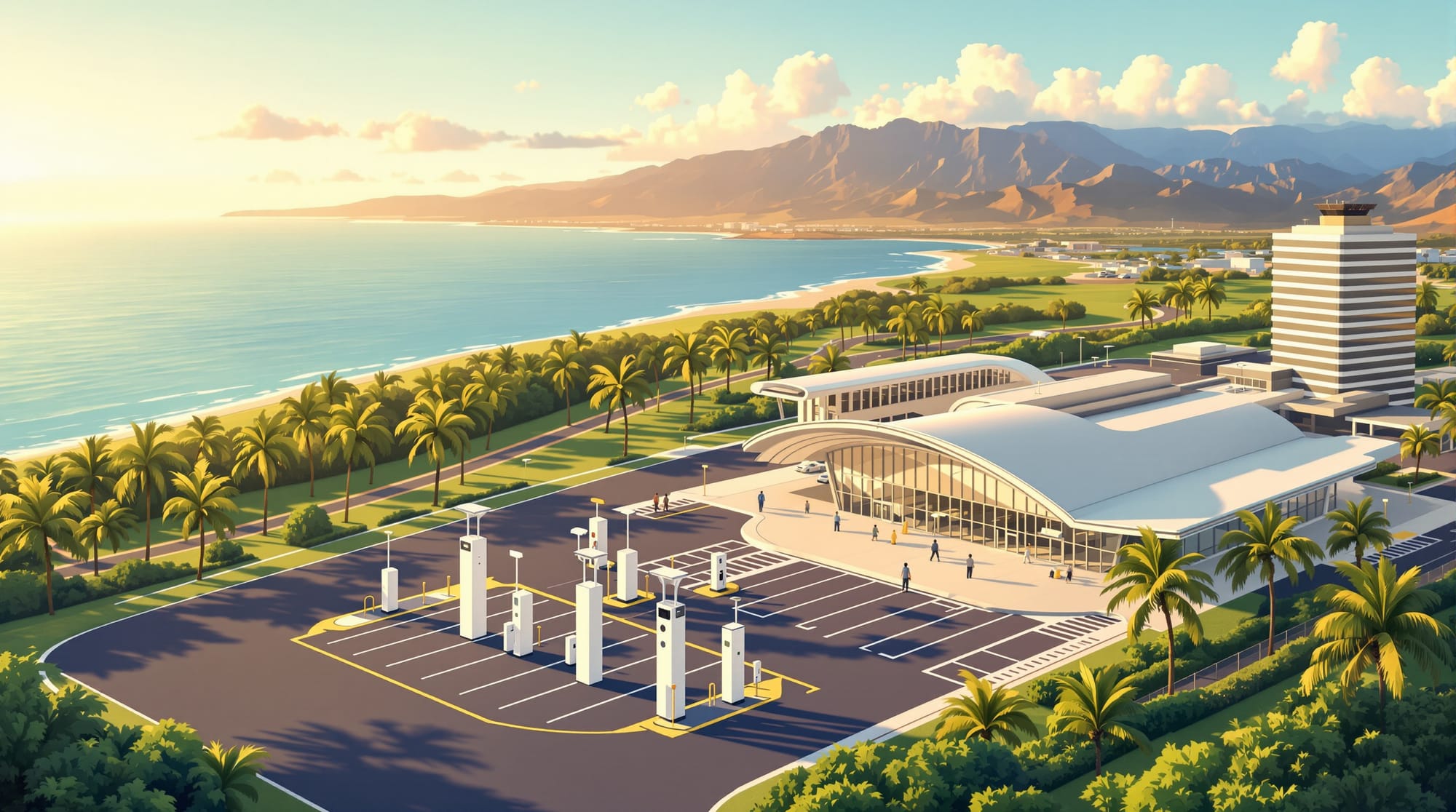
Hawaii's electric vehicle infrastructure rollout represents one of the most unique challenges in American transportation policy, and the state's latest milestone underscores just how different island logistics can be. The opening of a new NEVI-funded fast charging station at Kapalua Airport on Maui marks another strategic step in Hawaii's methodical approach to electrifying transportation across its isolated island chain.
The National Electric Vehicle Infrastructure (NEVI) program has funded charging stations across the continental United States, but Hawaii's implementation faces constraints that mainland states simply don't encounter. Every charging unit, every component, and every maintenance tool must be shipped across thousands of miles of Pacific Ocean. This reality shapes every decision in Hawaii's charging network expansion, making airport installations particularly strategic.
Kapalua Airport serves as a critical transportation hub for West Maui, handling both commercial flights and significant private aviation traffic. The airport's location makes it a natural waypoint for travelers exploring the island's resort areas and natural attractions. By positioning fast charging infrastructure at this transit nexus, Hawaii demonstrates an understanding that successful EV adoption requires charging availability at key movement corridors, not just urban centers.
The geographic isolation that defines Hawaiian logistics also creates unique opportunities for electric vehicle adoption. Islands operate as closed transportation systems where vehicles rarely travel the extreme distances common on the mainland. Maui spans roughly 48 miles at its widest point, making it an ideal testbed for electric vehicle viability. Range anxiety, one of the primary barriers to EV adoption nationally, becomes less relevant when your entire driving environment fits within a modern electric vehicle's single-charge capability.
Hawaii's approach to NEVI funding allocation reflects this geographic reality. Rather than focusing primarily on interstate highway corridors like most mainland states, Hawaii must consider inter-island transportation patterns and the unique role airports play in connecting isolated communities. The state's charging network strategy necessarily differs from the linear, highway-focused approach that dominates continental planning.
The timing of this Maui installation aligns with broader trends in Hawaiian energy policy. The state has committed to achieving 100 percent renewable electricity by 2045, making it the first U.S. state to set such an aggressive clean energy timeline. Electric vehicle adoption directly supports this goal by creating demand for renewable electricity while reducing dependence on imported petroleum products that currently power most Hawaiian transportation.
Airport charging installations also serve Hawaii's significant tourism economy, which depends heavily on rental vehicles. Tourists increasingly seek sustainable travel options, and the availability of convenient charging infrastructure can influence destination choices. For Hawaii's tourism-dependent economy, EV infrastructure becomes both an environmental necessity and an economic competitiveness factor.
The success of island-based EV networks like Hawaii's could provide valuable insights for other geographically constrained regions worldwide. Island nations and remote communities face similar challenges in balancing transportation electrification with logistical constraints and energy independence goals. Hawaii's methodical, airport-focused approach may offer a replicable model for other isolated markets pursuing transportation decarbonization.
Written by the editorial team — independent journalism powered by Pressnow.
Sources: Electrek · Thu, 21 May 2026