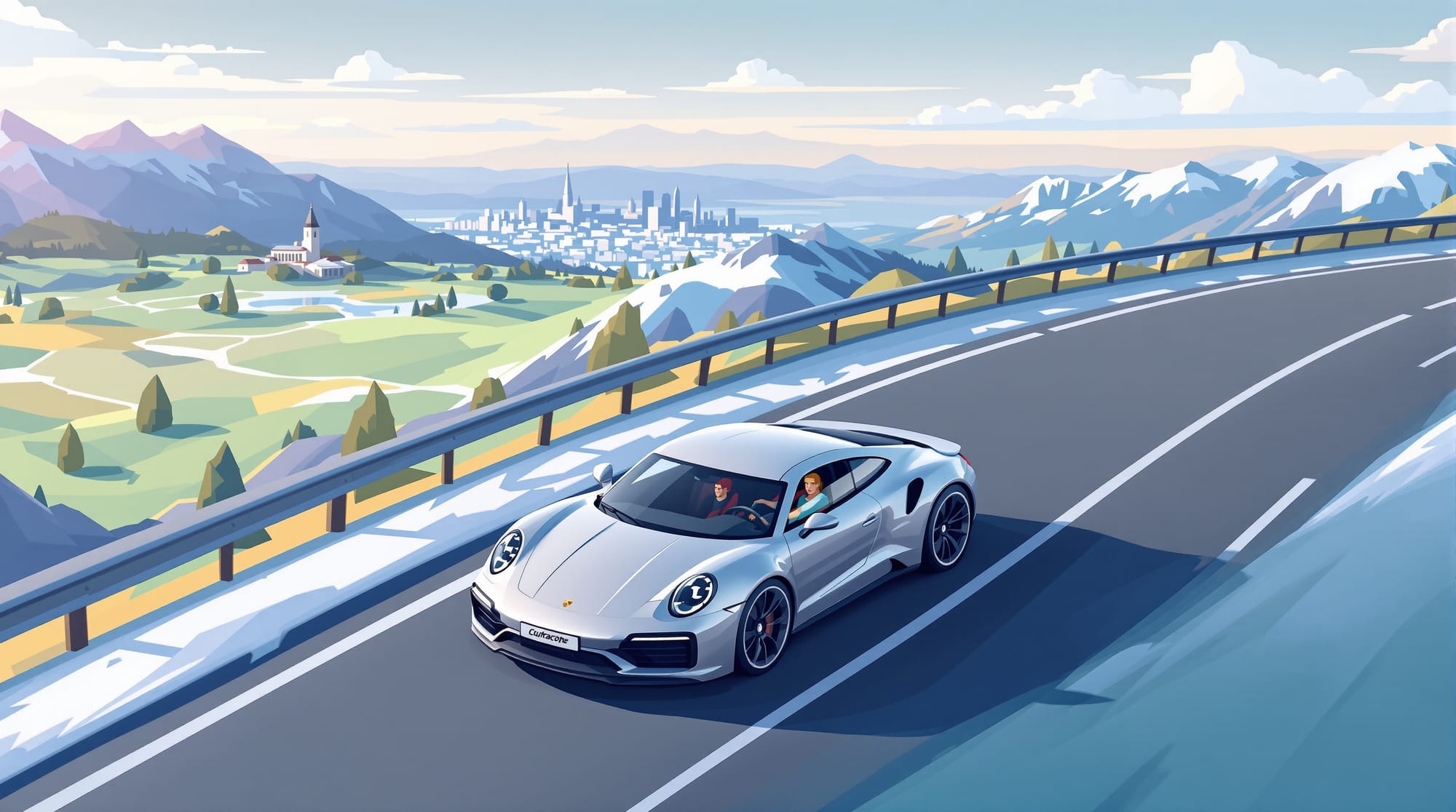
There are faster ways to travel between Milan and Stuttgart. You could take a train, book a flight, or simply look at a map and acknowledge that the two cities are separated by roughly 600 kilometres of Alps and Autobahn. But Quattroruote — Italy's oldest and most authoritative automotive magazine — chose a different method: cover the round trip in 24 hours, behind the wheel of the car that Porsche insists is the most complete 911 it has ever built. The result is one of the more instructive road tests of the year.
The subject is the 2026 Porsche 911 Turbo S Coupé, the 992.2-generation flagship that arrives carrying a genuinely significant technical departure: for the first time in the Turbo S lineage, electrification. For 2026, Porsche gives the Turbo S a new hybridised heart and a whopping 701 horsepower, an increase of 61 hp over the 2025 model. That figure, expressed in European power units, works out to 711 PS of system output — a power increase of 61 PS compared to the predecessor model.
The engineering behind that headline number is what makes this generation genuinely novel. Where the GTS hybrid system uses one turbocharger, the 911 Turbo S uses two. This twin-turbo setup feeds a 3.6-litre flat-six engine, and a 1.9-kWh battery pack feeds a motor that adds supplemental electric thrust for initial acceleration and to fill in power gaps at speed. For the first time, Porsche is using eTurbo technology in a 911 Turbo S. Unlike conventional turbochargers, eTurbos are each equipped with an integrated electric motor, which is located between the compressor and turbine wheels and drives the shaft of the turbocharger directly. As a result, it spools up the turbo at lightning speed, regardless of engine load. Full boost pressure is always available within a very short time.
This is not, Porsche is at pains to emphasise, a plug-in hybrid. It is a self-charging hybrid system that uses exhaust heat recuperation to generate electric power, echoing Porsche's 919 Hybrid Le Mans technology. The electric motor lives inside the housing of the eight-speed PDK (Porsche Doppelkupplung) dual-clutch gearbox rather than on the axle, meaning the electric motor is integrated directly within the PDK housing, providing seamless torque fill and boosting total system output — an architecture that not only enhances acceleration but maintains the visceral, mechanical feel enthusiasts expect from Porsche's most iconic performance machine.
The performance data are predictably eye-widening. According to Porsche, the new 911 Turbo S will sprint to 60 mph in just 2.4 seconds, a 0.2-second improvement over the current car. Maximum torque is 800 Nm, enabling the flagship sports car to accelerate from 0–100 km/h in 2.5 seconds, two tenths faster than its predecessor. At the other end of the speed range, the Turbo S will reach 200 mph on summer tyres. Most compellingly for those who distrust manufacturer test days, the car has already been timed on the Nürburgring Nordschleife: in final development testing conducted in autumn 2024, a lightly camouflaged 911 Turbo S recorded a time of 7:03.92 minutes, certified by notarial supervision — nearly 14 seconds faster than the previous model.
The Quattroruote test, published 3 May 2026 under the magazine's premium tier, deliberately eschews the racetrack. The real journey across the Alps and the Autobahn was designed to put the new 911 Turbo S to the test on extreme performance, unsuspected comfort, and a hybridisation engineered solely to go faster. The route: Milan–Stuttgart and back, in the most powerful 911, now featuring the T-Hybrid. At 1,200 km covered inside 24 hours, this is the grand-touring brief taken to its logical extreme — and precisely the kind of mission for which the Turbo S was conceived.
That dual identity — uncompromising performance machine and effortless continent-crosser — is, as Porsche frames it, the Turbo S's founding promise. "The 911 Turbo S is the most complete and versatile way to drive a Porsche 911. Whether in daily use, on long motorway drives or on the racetrack — we have been able to make the new 911 Turbo S even more comfortable, more individual and significantly faster than its predecessor," says Frank Moser, Vice President of the 911 and 718 model line.
The chassis architecture underpinning that claim is equally ambitious. There is a completely revised suspension, larger brakes and more efficient aerodynamics. Aerodynamic elements include an active rear wing, variable cool-air flaps up front, and for the first time, a dynamic, deployable front spoiler. The electro-hydraulic adaptive suspension is tied to the 400-volt system for quicker reactions, improved agility, and a more engaging drive experience. Up front, the 911 Turbo S rides on 20-inch wheels wrapped in 255/35-series tyres, but the rear 21-inch wheels now use wider 325/30 tyres. Behind those, you will find the largest carbon-ceramic brake system Porsche has ever installed on a 911.
Independent reviews from the international press — including Edmunds and Motor1 — corroborate the headline verdict. The 992.2 911 Turbo S has the spec sheet to scare almost any supercar — now with 701 horsepower — and a Nürburgring lap time that troubles the newly refreshed 992.2 GT3: 7:03.92 to the GT3's 6:56.2. That is shockingly close, especially considering the new Turbo S weighs 3,829 pounds to the GT3's 3,278 pounds. Yet it remains, inescapably, a Turbo S — standard equipment runs to 18-way power-adjustable sport seats, a Bose surround-sound system and rear-wheel steering, all wrapped in a cabin that MotorWeek described as equally at home on a racetrack as in rush-hour traffic.
The price for all of this is appropriately stratospheric. Pricing for the 2026 911 Turbo S starts at $272,650, including a $2,350 destination fee. In Europe, the new Porsche 911 Turbo S can be ordered from €280,157 including VAT. The 911 Turbo S Cabriolet starts from €294,667. Both body styles are now available.
What Quattroruote's 1,200-km odyssey ultimately tests is not whether the 2026 Turbo S is fast — that has never been in question — but whether the T-Hybrid architecture has disrupted the car's essential character. Based on the evidence assembled across Alpine passes and German motorways, the answer appears to be an emphatic no. The electrification serves pace rather than efficiency; the grand-touring soul remains. For a car that has always claimed to be the most complete 911, that continuity may be the most remarkable achievement of all.
Editor at slalallal — independent journalism on automotive.
Sources: Quattroruote — Porsche 911 Turbo S: 1.200 km in 24 ore (May 2026) · Porsche USA — Official 911 Turbo S product page · Edmunds — 2026 Porsche 911 Turbo S First Drive Review · Motor1 — 2026 Porsche 911 Turbo S Review · verified by editorial team