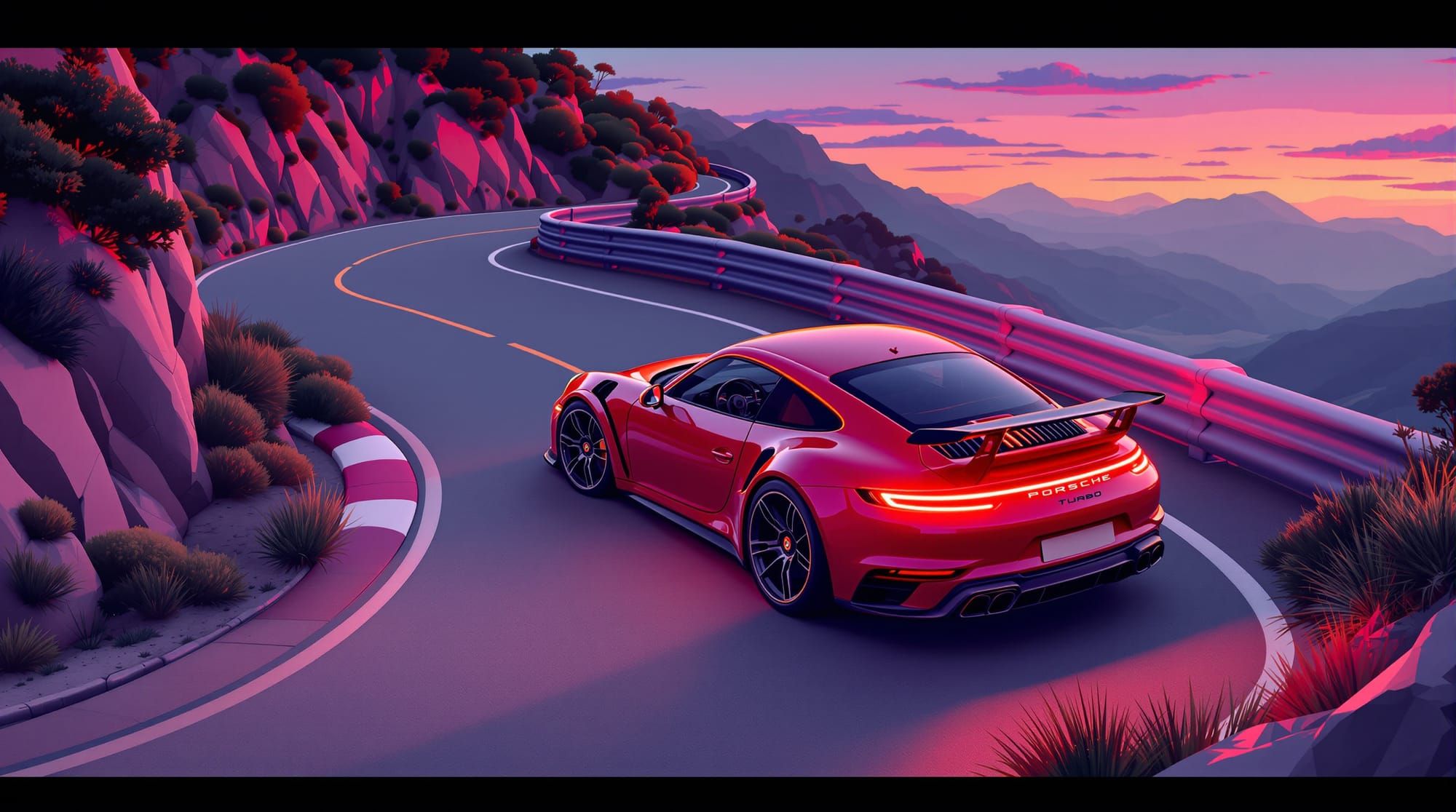
There is a peculiarly Italian way to find out whether a car is truly great: drive it for 1,200 kilometres in 24 hours and let the road — motorway, mountain pass, city ring road, late-night autostrada — deliver its verdict. That is exactly what Quattroruote did with the new Porsche 911 Turbo S, and the conclusion was not merely that it survived — it excelled. But then, this is no ordinary update to an ordinary car.
The Most Powerful 911 Ever Made
Despite appearances, the updated 992-generation Porsche 911 Turbo S — known to enthusiasts as the 992.2 — is a substantially new car. The standard Turbo has been quietly phased out, making this the standalone flagship of the 911 range. And it arrives carrying a powertrain that would have seemed outright fantastical a decade ago.
A redesigned 3.6-litre six-cylinder boxer engine, combined with a 400-volt T-Hybrid system and two lightning-fast e-Turbos, edges out the mighty GT2 RS by a single pony to hit 701 horsepower, allowing the 2026 Turbo S to claim top honours as the most powerful production 911 ever. Torque output tops out at 590 lb-ft, but it's more of a plateau than a peak, holding steady from below 2,000 to beyond 6,000 rpm. That broad, avalanche-flat torque curve is not incidental — it is the practical genius behind what makes the Turbo S so devastatingly effective in real-world conditions rather than merely on a dyno sheet.
Adopting a widely reworked version of the 3.6-litre hybrid flat six that the 992.2 Porsche 911 GTS received in 2025, the new Turbo S uses two smaller electrically roused turbochargers — one per bank — rather than just one. While the 911 GTS uses a single electric turbocharger, the Turbo S has two smaller eTurbos, which spin at up to 145,000 rpm to eliminate lag. They also act as generators for the hybrid battery when off-boost. The 400-volt architecture extends further than the engine bay: the influence of what has gone on in the engine bay even reaches the car's suspension and steering, with Porsche's T-Hybrid system enabling technical upgrades for the Turbo's PDCC active anti-roll bars and four-wheel steering systems.
Numbers That Embarrass Hypercars
The performance data is the kind that reframes the competitive landscape entirely. The 2026 Porsche 911 Turbo S accelerates to 60 mph in just 2.0 seconds, tying it with the Ferrari SF90 Stradale as the quickest gas-powered car Car and Driver has ever tested. The new Turbo S is 14 seconds faster around the Nürburgring than its predecessor, at 7 minutes, 3.9 seconds. That is not a rounding error — it is a chasm, a generational leap delivered not by stripping the car back to a track weapon, but by making it smarter and more electrified.
Ten years ago, the 918 Spyder was the pinnacle of Porsche's lineup, but even this hypercar that sold for around $900,000 when new has been bested by the new 911 Turbo S. The 918 Spyder and 911 Turbo S both completed the quarter-mile in 9.7 seconds. The democratisation of hypercar performance into a car that can also carry your luggage to a hotel and park in a multi-storey is, in its own understated way, one of the engineering stories of the decade.
The Weight Penalty and the Chassis Miracle
There is, inevitably, a physical cost to all this electrification. The Turbo S weighs 85 kg more than before, at 1,725 kg — and this is now measured without the rear seats. The hybrid hardware accounts for about 65 kg of the gain, with bigger brakes (420 mm and 410 mm carbon-ceramics front and rear respectively), wider rear wheels with 325-section rear tyres, and a body approximately 10 kg heavier after structural reinforcement to meet the latest legislation.
Yet the chassis engineering deployed to manage that mass is extraordinary. The latest Carreras had slightly overactive rear-steer and were over-damped; the Turbo S addresses those tendencies directly and rides beautifully, with supple dampers that soften bumps but respond to mid-corner inputs. Aerodynamic elements play a big part in keeping everything grounded, including an active rear wing, variable cool-air flaps up front, and — for the first time — a dynamic, deployable front spoiler. The electro-hydraulic adaptive suspension is tied to the 400-volt system for quicker reactions and improved agility.
Grand Tourer First, Supercar Second
The 1,200-km test format is the ultimate proof of the Turbo S's original brief. The Turbo was never meant to be Porsche's ultimate sports car; you can select one of the GT or RS models for that. Instead, this was a grand-touring car in its ultimate form: power, comfort, and modest practicality in a largely unassuming package. That identity has been reinforced, not diluted, by the move to hybrid power.
Luggage space remains excellent. Up-front storage is fine, with deep door pockets. But the capacious front boot and the ability to throw large bags into the rear of the car make the Turbo S far more suited to touring than any mid-engined alternative. Over 1,200 km in a single day, those details matter as much as the Nürburgring lap time.
Even with significantly more power, the 2026 Turbo S still keeps the smoothness and everyday usability that Porsche emphasises as making this "the most complete and versatile 911" yet. Top Gear concluded it deserves to inherit the throne as the best everyday supercar of them all. High praise — and, on the evidence of two dozen independent tests and one very long Italian road trip, entirely justified.
Price and the Question of Value
The Turbo S coupé starts at $272,650 in the United States, while the Cabriolet is $286,650 — an over $30,000 increase over the outgoing Turbo S models. In the United Kingdom, the coupé is priced at £199,100, almost exactly twice the price of a base 911 Carrera. Against the backdrop of what it actually delivers, considering the 911 Turbo S's absurd performance, its starting price feels like a bargain.
The context matters. A Bentley Continental GT — a full plug-in hybrid with 671 bhp and considerable luxury — is £202,565. An Aston Martin Vantage with 656 bhp costs £165,000. The Turbo S slots above both in capability, if not in theatre. Whether that cold efficiency is enough to justify the premium over a car that looks and sounds more exotic is, ultimately, a question of how you intend to spend your 1,200 km.
For those who want to spend them fast, comfortable, and without drama — and arrive at the other end feeling like they could do it all again — the answer has rarely been clearer.
Editor at slalallal — independent journalism on automotive, electric vehicles, motorsport, car industry; energy, renewables, oil & gas, utilities; gaming, esports, game development, platforms.
Sources: Top Gear — Porsche 911 Turbo S Review 2026 · Car and Driver — Tested: 2026 Porsche 911 Turbo S · Autocar — Tested: 2026 Porsche 911 Turbo S · Motor1 — This Is the New 911 Turbo S · verified by editorial team