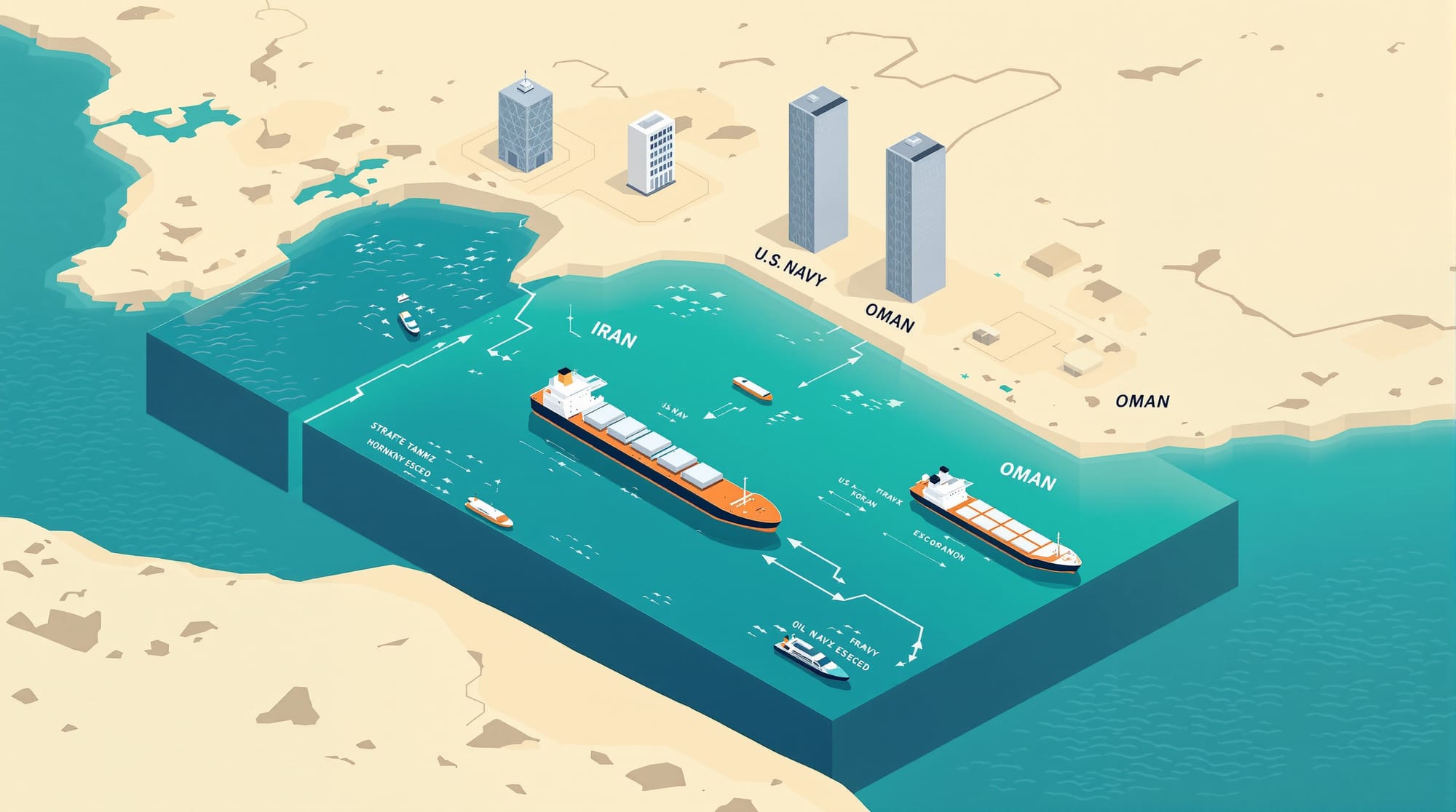
President Trump's announcement of "Project Freedom," a U.S. Navy initiative to guide vessels through the Strait of Hormuz, signals a fundamental shift in how America intends to secure global energy flows—and reveals the hidden costs of what appears, on the surface, to be a pro-market intervention. The immediate market response was predictable: oil prices dipped, with West Texas Intermediate (WTI) crude falling to $101.30 per barrel and Brent declining to $107.80. Coupled with OPEC+'s simultaneous announcement of a modest production increase, the confluence of events painted a picture of restored supply stability. Yet beneath this reassuring headline lies a more complex reality about energy independence, military overreach, and the structural fragility of global oil markets.
The Strait of Hormuz remains the world's most vital petroleum artery—approximately 21 million barrels of crude and liquefied natural gas (LNG) transit through its narrow passage daily, representing nearly one-quarter of global oil trade. That geographic vulnerability has long haunted energy planners and strategists. When Iran has threatened to close the strait or when regional tensions spike, oil markets convulse. The stranded vessels that Trump referenced in his announcement—likely caught in contested waters or held by regional actors—represent precisely the kind of friction point that destabilizes energy markets and raises prices across global economy. Clearing those blockages through American naval power offers what appears to be an elegant solution: restore the free flow of oil without waiting for diplomatic breakthroughs or negotiated settlements.
The problem, however, is that this approach trades short-term price stability for long-term strategic entanglement. By positioning U.S. Navy assets as the de facto guarantor of Strait security, the Trump administration is essentially declaring that American military force will permanently underwrite global energy commerce in one of the world's most contested regions. This is not energy independence—it is energy dependence managed through military rather than market mechanisms. The financial cost of maintaining such a presence, measured in fuel consumption, personnel deployment, and geopolitical risk, will ultimately be internalized somewhere. Either American taxpayers subsidize it, or oil prices remain artificially depressed because the true security costs are invisible to consumers at the pump.
OPEC+ leadership, unsurprisingly, welcomed the announcement. The cartel has watched nervously as American shale production, renewable energy expansion, and fuel efficiency standards gradually reduced global oil demand growth. A restoration of confidence in supply security—achieved through American military might rather than market competition—plays directly into OPEC's hands. Higher confidence in supply reliability can actually support higher prices by eliminating the risk premium that geopolitical uncertainty typically commands. The modest production increase that OPEC+ confirmed alongside this announcement should therefore be read as a calculated move: produce slightly more, knowing that American security guarantees will prevent the kind of competitive price collapse that unconstrained supply might trigger.
For energy markets, the immediate consequence is a modest correction downward, but this should not be mistaken for a structural shift toward energy abundance or cheaper fuel. Rather, what we are witnessing is a recalibration of risk. The old model—where OPEC production cuts, regional tensions, and supply disruptions drove price volatility—is being replaced by a model where American military presence becomes the stabilizing variable. This shifts the volatility elsewhere: perhaps toward currency markets as the U.S. takes on new fiscal obligations, or toward geopolitical risk in other regions as American assets are concentrated in the Gulf. It also creates a new moral hazard. When the U.S. Navy ensures unobstructed tanker passage, it removes incentives for regional powers to develop their own naval capabilities or pursue diplomatic solutions that might be more durable.
The rhetoric around "Project Freedom" deliberately invokes the language of market liberalism and anti-statism—the idea that America is simply ensuring freedom of navigation and removing artificial barriers to commerce. Yet the mechanism is fundamentally statist: it relies on the projection of military power by the world's largest government. This contradiction reflects a deeper confusion in contemporary American energy policy. The same administration that champions deregulation and market-driven solutions has concluded that the world's most critical energy chokepoint cannot be left to market forces or regional diplomacy. It must be controlled through the barrel of a gun.
What this means for energy markets and policy is that the era of simple, decoupled energy security is over. Producers in North America may pump freely, but that independence is conditional on American military dominance in the Persian Gulf. Consumers may enjoy modestly lower prices today, but they are purchasing that stability with geopolitical risk that will likely compound over years. And OPEC+ members, despite the appearance of a level playing field, have gained a powerful ally in keeping global supply constrained and prices supported at levels that justify their own production discipline.
The test of "Project Freedom" will not be its initial market impact, but whether it proves durable. How long can the U.S. maintain this commitment? What happens when regional tensions inevitably resurface? And most critically: is there any exit strategy, or have we just locked in a permanent military presence designed to manage a resource that most analysts believe will become steadily less central to the global economy over the coming decades? Those are the questions that should concern energy investors, policymakers, and citizens far more than the modest, momentary decline in crude prices.
Written by the editorial team — independent journalism powered by Pressnow.
Sources: OilPrice · May 3, 2026